A Tale of Two Wars
My trip to visit Lorenz DL6NCI started at 0910 MET on the 19th March 2003.
To cover the 500kms to Hof required three train journeys and over seven
hours of traveling. The weather was wonderful as I left the train station
on the German ICE (Inter City Express) and it stayed that way for the whole
journey. The first third of the journey to Stuttgart was spent in the Neckar
valley, not good for any form of radio activity above 30 MHz, but extremely
scenic. At Tuttlingen I saw around twenty steam trains in a siding in need
of some TLC. Otherwise the journey was uneventful and I arrived at Stuttgart
train station on time. Stuttgart appears to built on the walls of a crater
leading to a very intriguing layout to the place. This also means that
serious microwave activity from the city itself is out of the question,
however just to the south of the city are some satellite towns that are on a
high plain and have clear take-offs in all directions.
The next part of the journey from Stuttgart to Nürnberg was also
uneventful. This time the train was simply an IC (Inter City) which meant
that it stopped more often than an ICE but traveled at around the same
speed. The train lines in southern Germany are twisting because of having to
follow valleys and the full speed of the trains cannot be achieved. I
arrived at Nürnberg and had a gap of twenty minutes until my next train,
another ICE, was ready to go. This time it was a diesel ICE as the line is
not electrified, we were five minutes late leaving Nürnberg and it got worse. The train only stopped at one stop between
Nürnberg and Hof,
Bayreuth, a name that along with Nürnberg has a certain resonance. In German Bayreuth is pronounced almost the same as Beirut is in
English, a little confusing.
 At this stage of the journey I phoned ahead to Lorenz and told him that I
would be arriving on time, big mistake. After leaving Bayreuth the ICE
became an "Inter City Extremely slow", and we moved extremely slowly through
the Bavarian countryside. I decided to read the supplied train magazine and
read an article about Ellen MacArthur the yachtswoman who comes from
Whatstandwell in Derbyshire and went to the same school as me. A small
world. After a while I looked out of the window and saw three masts which I
guessed contained the DB0KI and DB0FGB beacons, the presence of the third
one was surprising for me though. The train eventually arrived in Hof about
thirty minutes late after being given a push by some passing snails who felt
sorry for it. Poor old Lorenz and his son Manuel had waited all that time
for me. Although the sun was still out at 1650 MET, there was also a cold
wind which must have made it a thoroughly miserable experience for them.
At this stage of the journey I phoned ahead to Lorenz and told him that I
would be arriving on time, big mistake. After leaving Bayreuth the ICE
became an "Inter City Extremely slow", and we moved extremely slowly through
the Bavarian countryside. I decided to read the supplied train magazine and
read an article about Ellen MacArthur the yachtswoman who comes from
Whatstandwell in Derbyshire and went to the same school as me. A small
world. After a while I looked out of the window and saw three masts which I
guessed contained the DB0KI and DB0FGB beacons, the presence of the third
one was surprising for me though. The train eventually arrived in Hof about
thirty minutes late after being given a push by some passing snails who felt
sorry for it. Poor old Lorenz and his son Manuel had waited all that time
for me. Although the sun was still out at 1650 MET, there was also a cold
wind which must have made it a thoroughly miserable experience for them.
 The journey to Lorenz's house only took fifteen minutes and I was happy to
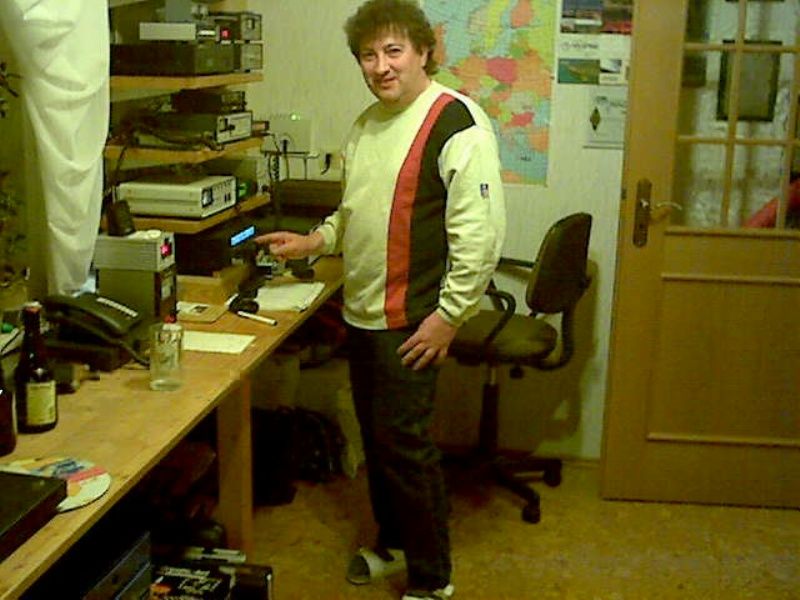
arrive and have someone to talk to. I was introduced to Lorenz's wife, Jutta
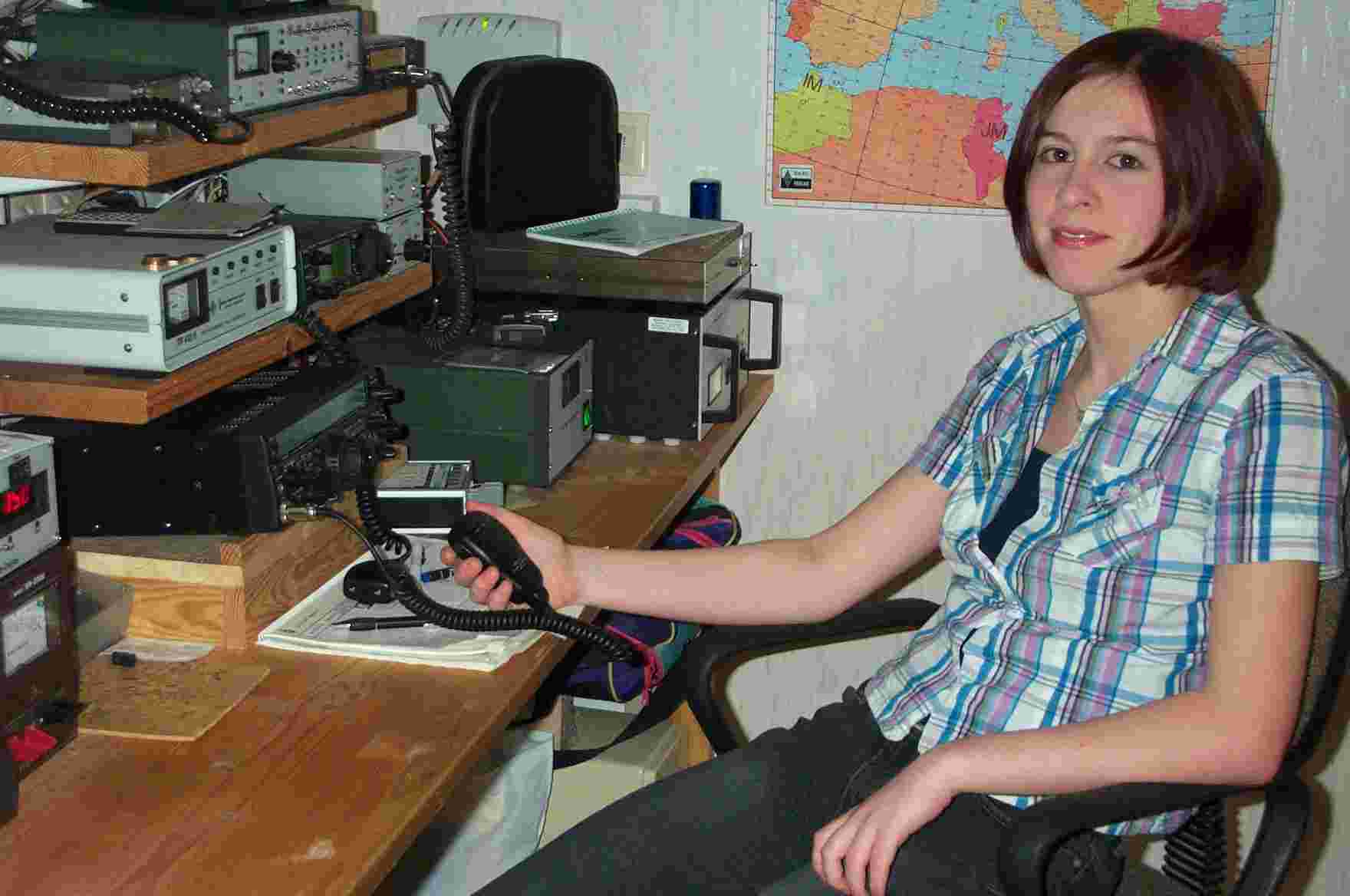
DL6NCR. I was then shown around the house, shown the
shack and then my room. I had promised (threatened ?) them that I would cook
a meal for the family, in fact I had brought some ingredients from
Switzerland to guarantee the flavour. I cooked them Chilli Chicken which is
an invention of my wife who is a Malaysian Indian, and they seemed to like
it, or perhaps they were just being polite. At least no one died.
The journey to Lorenz's house only took fifteen minutes and I was happy to
arrive and have someone to talk to. I was introduced to Lorenz's wife, Jutta
DL6NCR. I was then shown around the house, shown the
shack and then my room. I had promised (threatened ?) them that I would cook
a meal for the family, in fact I had brought some ingredients from
Switzerland to guarantee the flavour. I cooked them Chilli Chicken which is
an invention of my wife who is a Malaysian Indian, and they seemed to like
it, or perhaps they were just being polite. At least no one died.
 We went back into the shack and saw that there was a tropo opening on 2m
between DL/PA and G/GM so we switched the 2m radio on and listened around.
We heard Tim G4LOH (IO94IA) calling CQ on CW and John GM0OYT (IO87WD)
working a pile-up on SSB. We persuaded Sabrina DB6NI, Lorenz's daughter, to
work him as it would be a new best DX for her on any band. She did and got a
59 report. This is the same DB6NI who jointly holds the region one
rain-scatter record on 3cms at 961kms.
We went back into the shack and saw that there was a tropo opening on 2m
between DL/PA and G/GM so we switched the 2m radio on and listened around.
We heard Tim G4LOH (IO94IA) calling CQ on CW and John GM0OYT (IO87WD)
working a pile-up on SSB. We persuaded Sabrina DB6NI, Lorenz's daughter, to
work him as it would be a new best DX for her on any band. She did and got a
59 report. This is the same DB6NI who jointly holds the region one
rain-scatter record on 3cms at 961kms.

 Lorenz explained that we are in a part of Germany that was located in the
corner where East Germany and Czechoslovakia met, and that this shaped their
lives until 1989. We continued chatting for a while and drinking one of the
local beers, Ahornberger Landbier which is excellent. I went to bed at a decent
time as I was now feeling very tired from all my traveling.
Lorenz explained that we are in a part of Germany that was located in the
corner where East Germany and Czechoslovakia met, and that this shaped their
lives until 1989. We continued chatting for a while and drinking one of the
local beers, Ahornberger Landbier which is excellent. I went to bed at a decent
time as I was now feeling very tired from all my traveling.
When I walked into the kitchen on the Thursday morning, Lorenz told me that
the Gulf War had started, the radio was left on in the background so that we
could hear what was going on. My German is not very good but I could
understand the main gist of the reports.

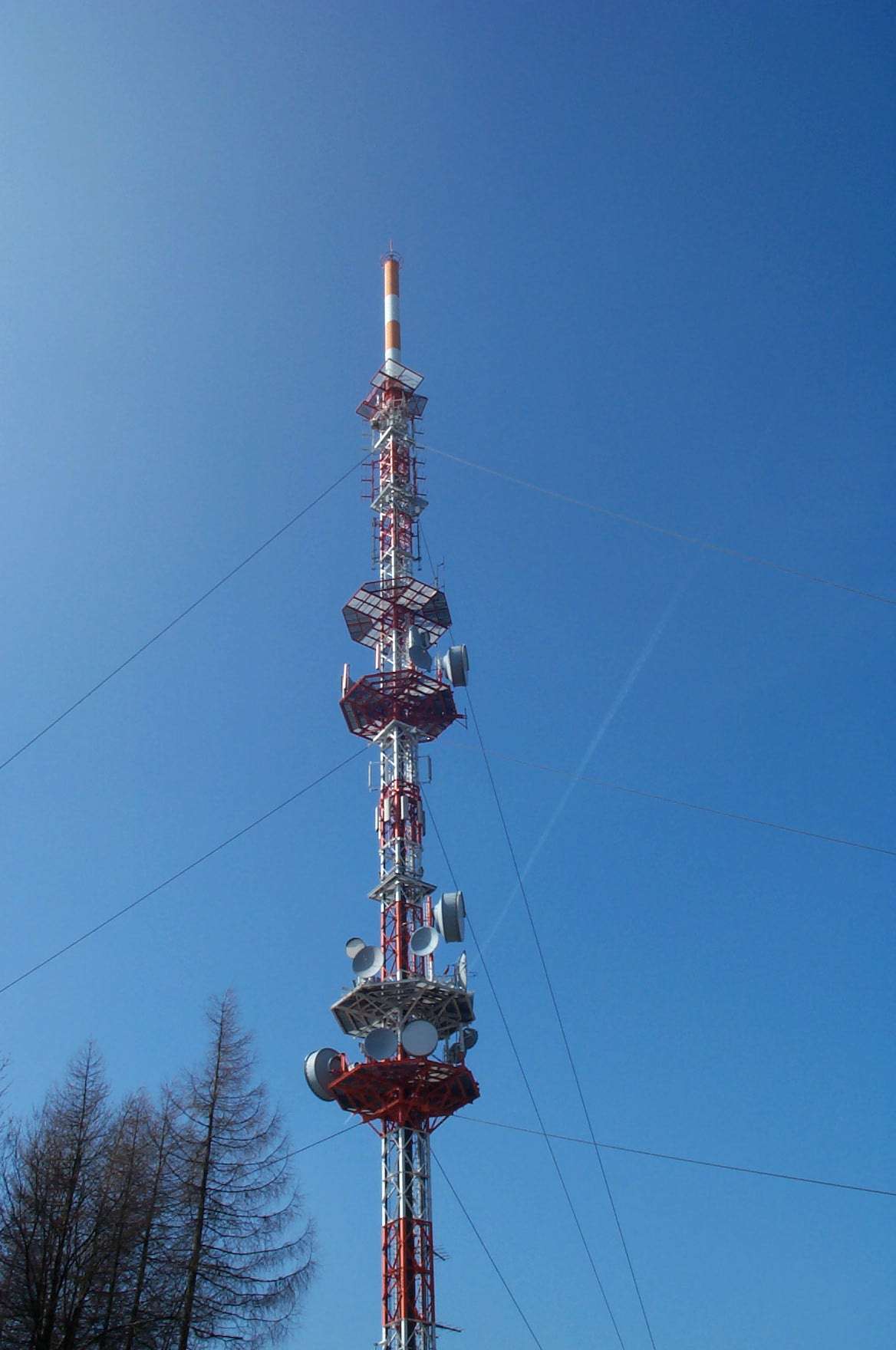
 After breakfast we left the house and traveled in the car to Lorenz's work
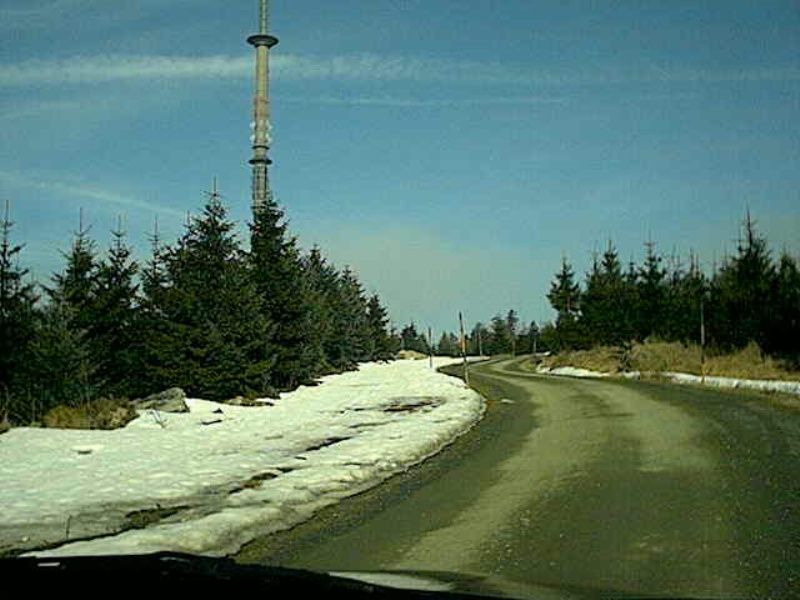
location at Ochsenkopf (Oxes Head) in JO50VA and 1024m ASL at its base. This is a transmitter for
Bayerischer Rundfunk, the Bavarian broadcaster. This was the highest mast of the
three that I had seen earlier. The other masts were indeed DB0KI and DB0FGB
as I had guessed. Lorenz gave me a complete tour of the installation except
for the climb up the 163m mast itself. The site contains transmitters for
radio and television on various frequencies, but nothing too high powered.
The transmitters were all duplicated and controlled by computers, running
Windows 3.1, shocking. One of the services transmitted is a digital audio
service on 230 MHz which is available throughout Bavaria, we were listening
to it all of the time in the car.
After breakfast we left the house and traveled in the car to Lorenz's work
location at Ochsenkopf (Oxes Head) in JO50VA and 1024m ASL at its base. This is a transmitter for
Bayerischer Rundfunk, the Bavarian broadcaster. This was the highest mast of the
three that I had seen earlier. The other masts were indeed DB0KI and DB0FGB
as I had guessed. Lorenz gave me a complete tour of the installation except
for the climb up the 163m mast itself. The site contains transmitters for
radio and television on various frequencies, but nothing too high powered.
The transmitters were all duplicated and controlled by computers, running
Windows 3.1, shocking. One of the services transmitted is a digital audio
service on 230 MHz which is available throughout Bavaria, we were listening
to it all of the time in the car.
 Probably the most impressive part was the switch gear for the incoming
national grid connections. The location has impressive views in all
directions. Interesting fact, the station does not have a standby generator
because of fears about pollution as water is collected from the mountain for
drinking, so two different electricity feeds are used instead. I was also
shown the transmitting valves that are used, they have carrying handles !
Probably the most impressive part was the switch gear for the incoming
national grid connections. The location has impressive views in all
directions. Interesting fact, the station does not have a standby generator
because of fears about pollution as water is collected from the mountain for
drinking, so two different electricity feeds are used instead. I was also
shown the transmitting valves that are used, they have carrying handles !
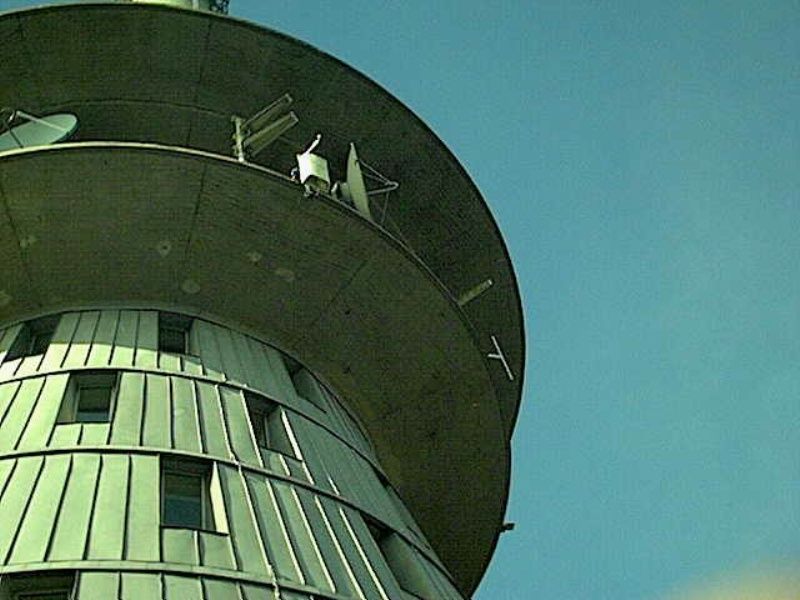
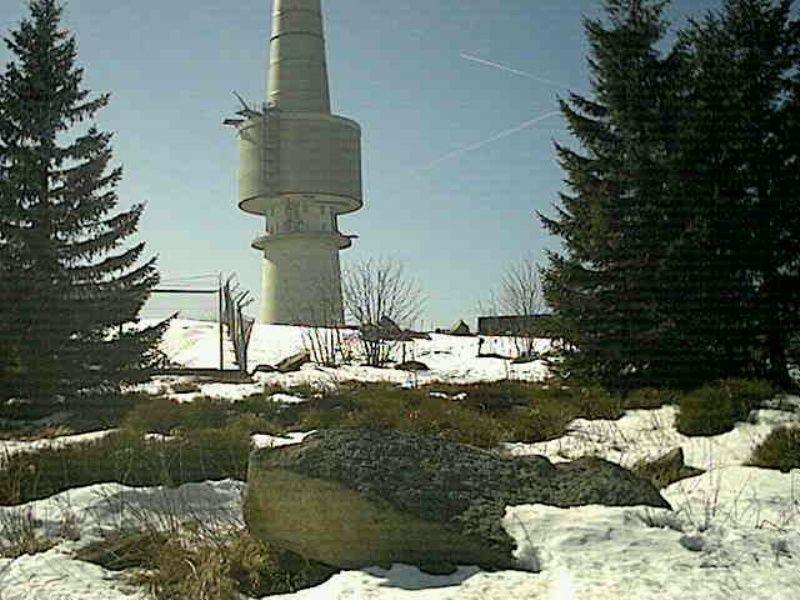
 After spending an hour there, we moved onto Schneeberg (Snow Mountain), the
location of DB0FGB (JO50WB, 1054m ASL). This transmitter site was used by the Americans
in the cold war to keep an electronic eye on East Germany, Czechoslovakia and
Russia. Unlike most transmitter masts this one has a large enclosed
space where all the antennas are located, here they are kept at a constant
temperature and away from wind and rain. Since the end of the cold war, the
mast was bought by a mobile phone company that has since become known as
Vodafone.
As well as the mast, there are a complete set of barracks on the site which
are now empty. To get to the mast, we had to park the car at the bottom of
the mountain and make a 4km walk up to it. Thankfully the weather was just
above freezing which meant that the walk was not too hot, but being
incredibly unfit that I am, it was very tiring for me.
After spending an hour there, we moved onto Schneeberg (Snow Mountain), the
location of DB0FGB (JO50WB, 1054m ASL). This transmitter site was used by the Americans
in the cold war to keep an electronic eye on East Germany, Czechoslovakia and
Russia. Unlike most transmitter masts this one has a large enclosed
space where all the antennas are located, here they are kept at a constant
temperature and away from wind and rain. Since the end of the cold war, the
mast was bought by a mobile phone company that has since become known as
Vodafone.
As well as the mast, there are a complete set of barracks on the site which
are now empty. To get to the mast, we had to park the car at the bottom of
the mountain and make a 4km walk up to it. Thankfully the weather was just
above freezing which meant that the walk was not too hot, but being
incredibly unfit that I am, it was very tiring for me.
After reaching the top Lorenz walked, and I crawled, to the lookout position
at the top named Backöfele. Until two years previously this location had
been within the perimeter of the mast and not publicly accessible.
Thankfully this has now changed and the views from it are tremendous.
A common theme throughout my tour of this area was BBT Bayerischer Bergtag
(Bavarian Mountain Day), a series of contests similar in concept to the RSGB
Backpackers contests except that it is for all bands from 2m to microwaves and
are held in the Winter and the Summer.
Almost every location in the area has been used for BBT at one time or
another and it is a very good way of raising activity levels. These
contests, a cumulatives type of event celebrate their fiftieth year in 2004, and
are not restricted to stations in Bavaria. Ferdi HB9MIO is
particularly keen on it and usually does very well in them. I can't help
wondering whether such a contest would be viable in the UK.
 The walk back from 'FGB was somewhat easier. We still had one more beacon to
visit and it was still before midday ! Next we went to the site of DB0KI at
Waldstein in JO50WC and 880m ASL at its base, thankfully the car can get rather close to it and the
walking is kept to a minimum. This mast is owned by Deutsche Telekom and is
used for broadcasting the German commercial channels as well as other
services. The beacons are located well up the mast and taking binoculars was
essential to see them. Interesting fact, the 3cms beacon at DB0KI is located
less than one metre from a 40kW broadcast antenna and this put some hum
modulation onto the transmission. From my location here in Switzerland DB0KI
on 23cms is a very useful indicator of conditions since it comes up out of
the noise quite easily.
The walk back from 'FGB was somewhat easier. We still had one more beacon to
visit and it was still before midday ! Next we went to the site of DB0KI at
Waldstein in JO50WC and 880m ASL at its base, thankfully the car can get rather close to it and the
walking is kept to a minimum. This mast is owned by Deutsche Telekom and is
used for broadcasting the German commercial channels as well as other
services. The beacons are located well up the mast and taking binoculars was
essential to see them. Interesting fact, the 3cms beacon at DB0KI is located
less than one metre from a 40kW broadcast antenna and this put some hum
modulation onto the transmission. From my location here in Switzerland DB0KI
on 23cms is a very useful indicator of conditions since it comes up out of
the noise quite easily.

 Next was a visit to Reinhold DL6NAA at his remote shack in JO50VF. This was
the most impressive amateur system that I saw in the whole trip, his shack
has access to serious power on all bands from 160m to 23cms inclusive. His
limitation is the electricity supply which is not as robust as most people
would like. He has three masts and normally has EME capable antennas for 2m
and 70cms up, however there had been a problem a couple of weeks before and
the 70cms system is now down, awaiting a rebuild. It was very pleasing that
Reinhold remembered my callsign from my DX activities on 2m and 70cms during
the 1980s.
Next was a visit to Reinhold DL6NAA at his remote shack in JO50VF. This was
the most impressive amateur system that I saw in the whole trip, his shack
has access to serious power on all bands from 160m to 23cms inclusive. His
limitation is the electricity supply which is not as robust as most people
would like. He has three masts and normally has EME capable antennas for 2m
and 70cms up, however there had been a problem a couple of weeks before and
the 70cms system is now down, awaiting a rebuild. It was very pleasing that
Reinhold remembered my callsign from my DX activities on 2m and 70cms during
the 1980s.
At this stage we went searching for some food, in particular the Bavarian
version of fast food. We found some in a small town and so I had my first
taste of Bratwurst, sausages. We have Bratwurst in Switzerland also but they
taste nothing like the ones the Germany, I think the difference is that the
ones in Germany contain meat. I hesitate to think what the Swiss versions
contain.

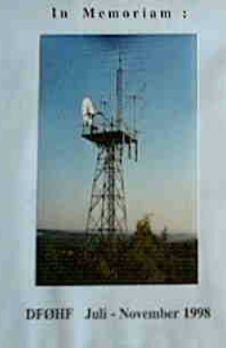
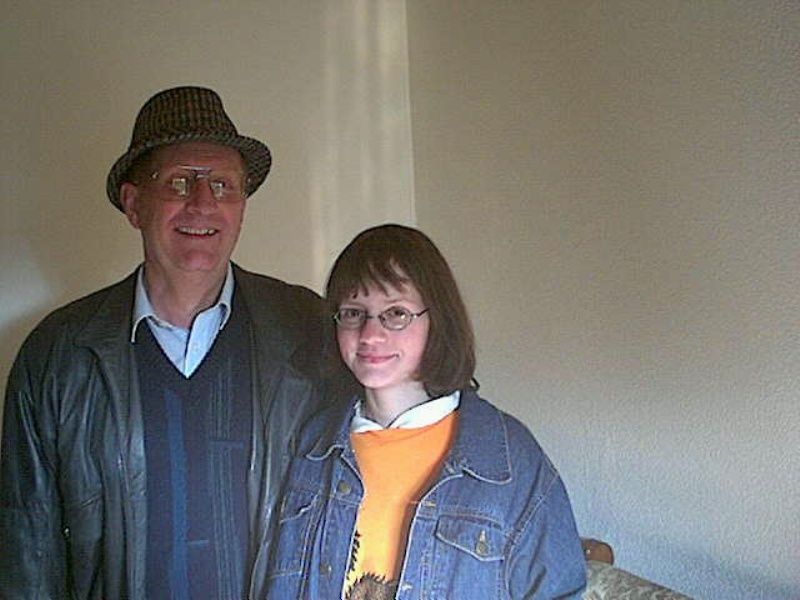
 After our refueling stop we did our last visit of the day, to the DF0HF
club station in JO50SF. Here we met Wolfgang DK2EA and his daughter Violetta
DH1NVM who is the youngest amateur in Germany. This club site is another cold war left
over as it had been another monitoring station, and how. The club has a
large wooden built club house, a 33m high mast and a massive underground
bunker where the radio gear is located. The mast is a large four-legged
beast with a platform at the top where the V/U/SHF antennas are located.
Previously they had had a huge antenna farm which included a 4m solid dish
and a two element beam for 40m ! and then a storm came. The current antennas
are only a shadow of their former glories but there are plans to upgrade
them.
After our refueling stop we did our last visit of the day, to the DF0HF
club station in JO50SF. Here we met Wolfgang DK2EA and his daughter Violetta
DH1NVM who is the youngest amateur in Germany. This club site is another cold war left
over as it had been another monitoring station, and how. The club has a
large wooden built club house, a 33m high mast and a massive underground
bunker where the radio gear is located. The mast is a large four-legged
beast with a platform at the top where the V/U/SHF antennas are located.
Previously they had had a huge antenna farm which included a 4m solid dish
and a two element beam for 40m ! and then a storm came. The current antennas
are only a shadow of their former glories but there are plans to upgrade
them.
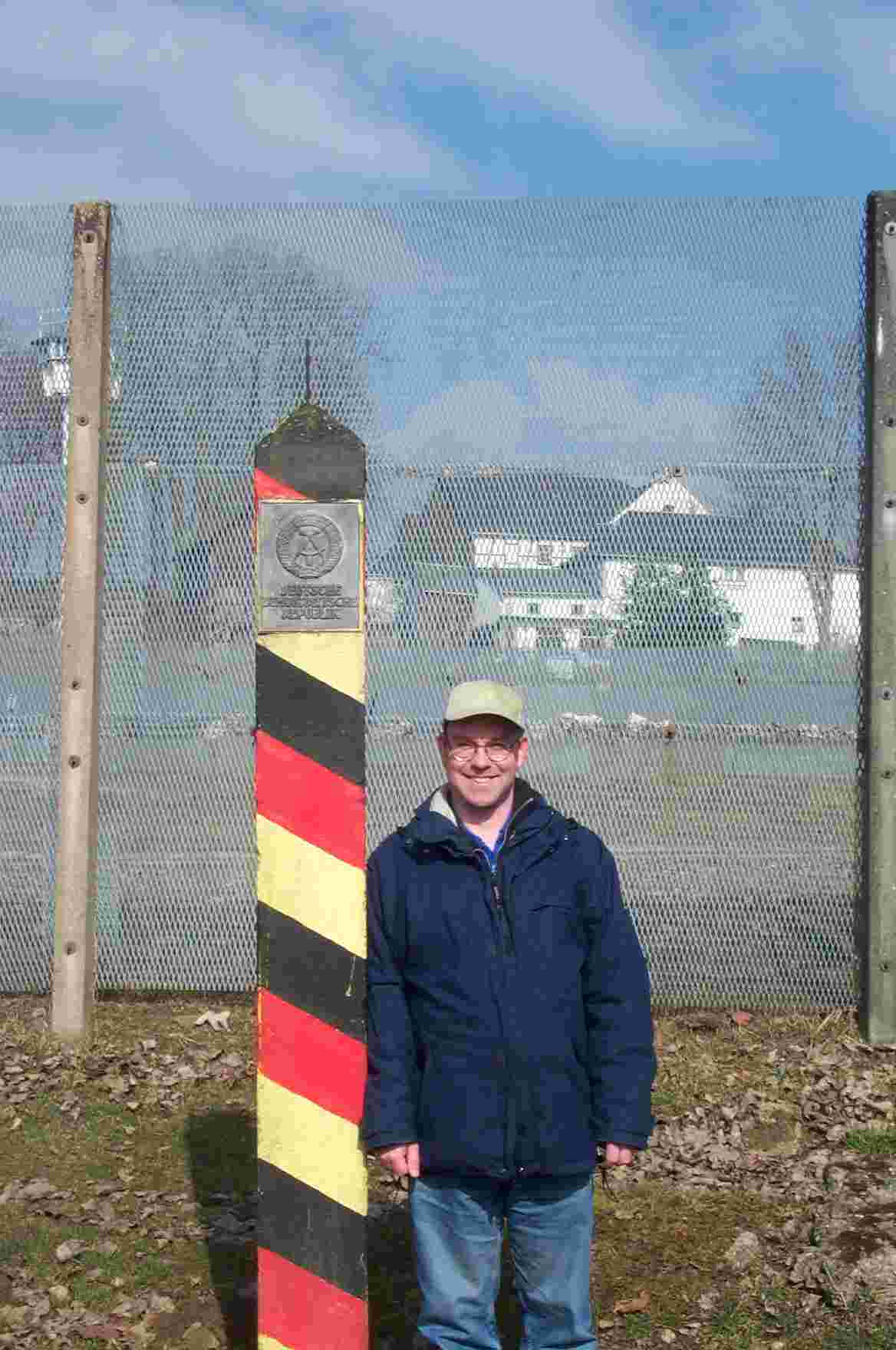
We then went home, passing near to the DK0NA club station, and my first view
of what was the old GDR. We were driving along a road and I was looking out
at the land when Lorenz pointed out to me that I was looking at the old GDR.
The old border was down in the valley between us and the fields, and it
really shocked me, the total banality of it all. The next day was when I was
going to come face to face with that bit of history. Lorenz took me past
DB6NT's home location, the address that people will have used for ordering
his parts until recently, it is in a very pretty place. It is also the
worst microwave location in the world.
Still no sleep for the wicked, with my aching limbs, we (that is, Lorenz,
Sabrina and I) went to a restaurant to meet up with Michael DB6NT, his son
Matthias DK5NJ and Erwin DJ5HN. We talked about many things and I ate a
large lump of Lamb, Vegetarians have a hard time in Bavaria.
The conversation ran across lots of topics, but one that came up was
microwaves in the UK. It was said to me that German microwavers used to look
towards the UK for the best designs and ideas, and they believed that we
were the most advanced microwave designers and operators in Europe. About
twenty years ago this all seemed to stop suddenly and people like Michael
DB6NT were left to pick up the baton. We discussed what the future may hold
with new components that promise cheaper power on 24GHz and 47GHz.
Apparently 250mW of 47GHz makes your finger warm if you put it over an open
waveguide !
 Friday was to be my last full day in JO50, but what a day. After breakfast
we headed to the old GDR and to the Grenzlandmuseum (Border Museum) at Mödlareuth. This was quite a long drive and we crossed the border at
another location, here the border was signified by a small river. It is all
very calm now but before 1989 this would have been a much more dangerous
place to be, it was probably one of the most strongly defended borders in
the world. Lorenz told me that he and Michael believed that the DK0NA club
station was visited by GDR agents when it was being built in 1980, since it
was within a short distance of the border and at first sight looked
suspicious.
Friday was to be my last full day in JO50, but what a day. After breakfast
we headed to the old GDR and to the Grenzlandmuseum (Border Museum) at Mödlareuth. This was quite a long drive and we crossed the border at
another location, here the border was signified by a small river. It is all
very calm now but before 1989 this would have been a much more dangerous
place to be, it was probably one of the most strongly defended borders in
the world. Lorenz told me that he and Michael believed that the DK0NA club
station was visited by GDR agents when it was being built in 1980, since it
was within a short distance of the border and at first sight looked
suspicious.

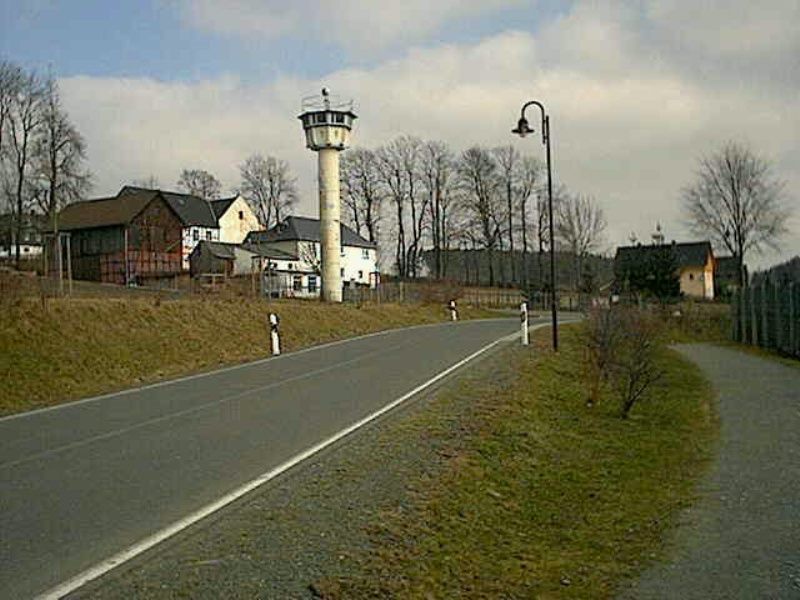
 We arrived at the museum in mid morning, it was very easy to see as there
was a large white wall that stood out from the rest of the countryside. We
parked in the car park (on the east side of the wall) and walked towards the
outdoor exhibits. The village of Mödlareuth spans two German Länder (Regions), and
this was also the border between the Russian and American zones after the
war. The solid wall that we could see was built in the 1960s but the first
wall that split the village in two was built in the 1950s. Now a 100m
section of it has been kept as an exhibit as well as other items from that
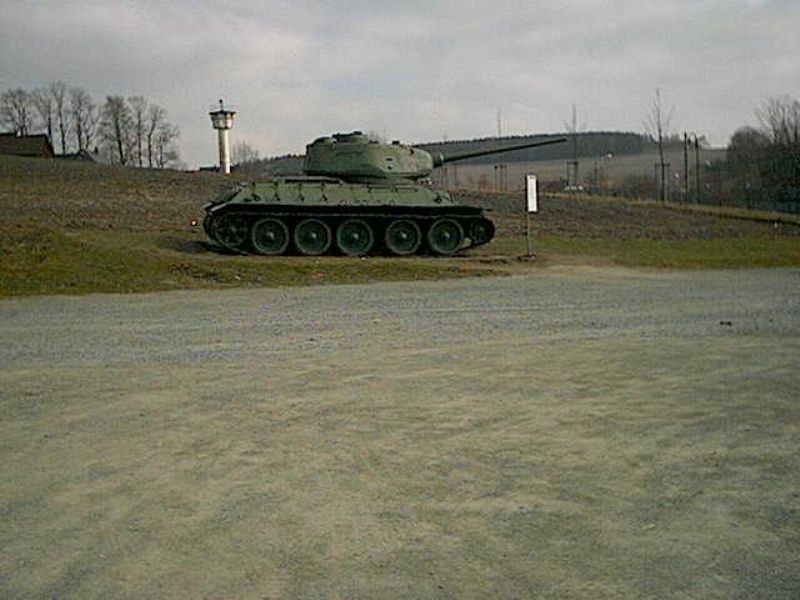
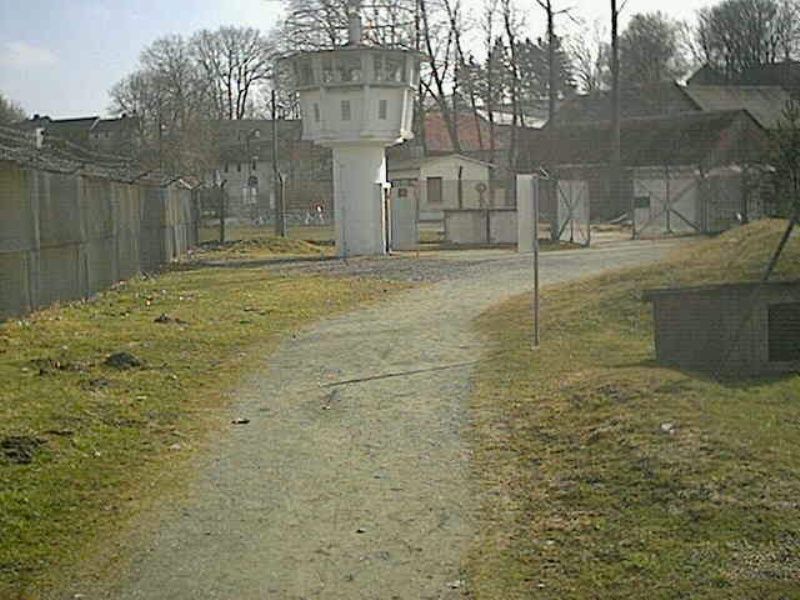
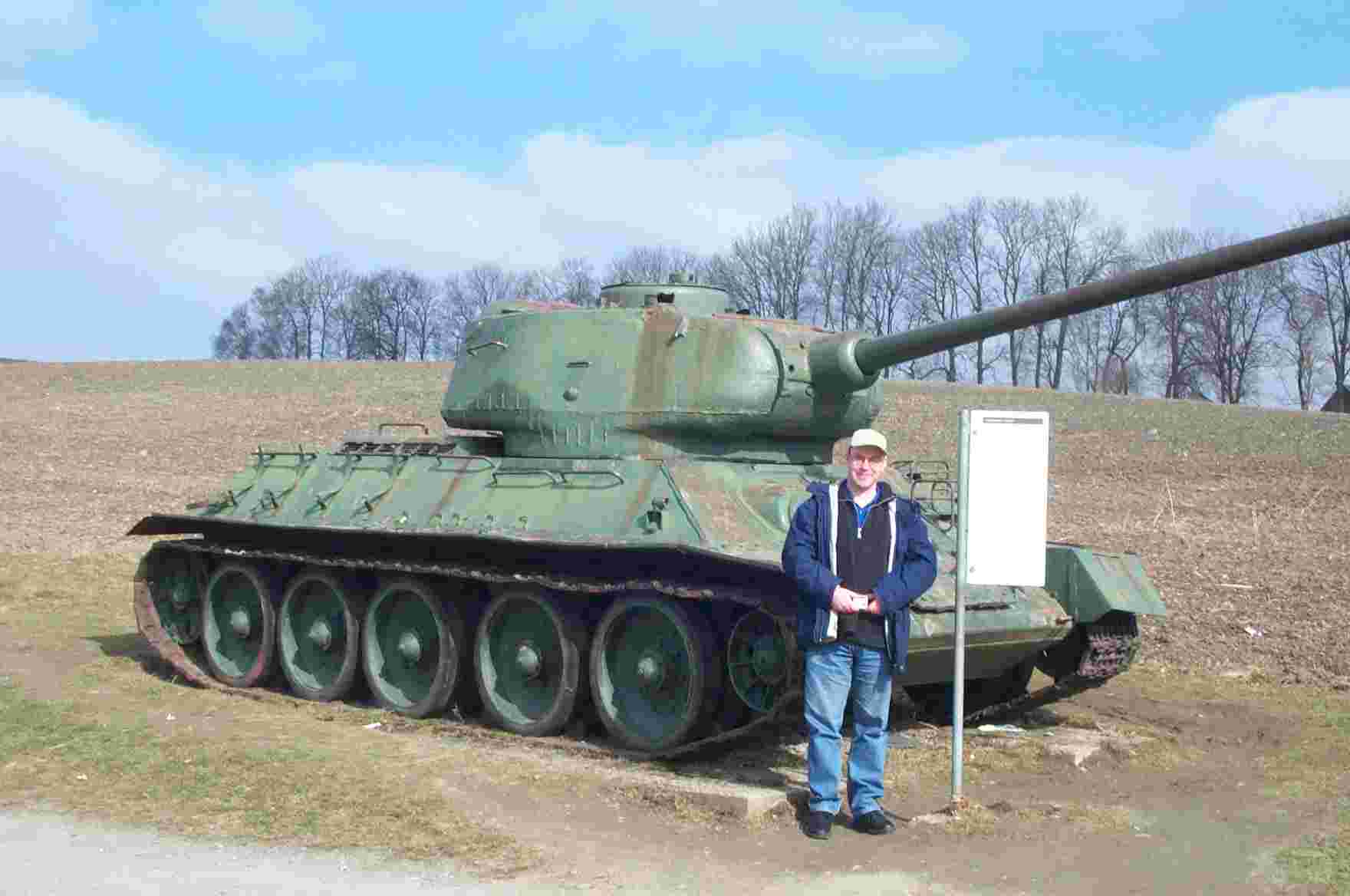
time, a guard tower, border posts, etc. By the car park was a Russian T34
tank and a Hind helicopter.
We arrived at the museum in mid morning, it was very easy to see as there
was a large white wall that stood out from the rest of the countryside. We
parked in the car park (on the east side of the wall) and walked towards the
outdoor exhibits. The village of Mödlareuth spans two German Länder (Regions), and
this was also the border between the Russian and American zones after the
war. The solid wall that we could see was built in the 1960s but the first
wall that split the village in two was built in the 1950s. Now a 100m
section of it has been kept as an exhibit as well as other items from that
time, a guard tower, border posts, etc. By the car park was a Russian T34
tank and a Hind helicopter.
 We went to the museum proper on the west side and looked at the exhibits.
They are all labeled in German, but my understanding was good enough to get
the essential information out. Lorenz told me about the procedure for
crossing the border when they used to meet up with the microwave operators
in the GDR, and smuggle components like GaAsFETs that were needed to get active
on microwaves. At least the amateur spirit knows no boundaries. We then
watched a short video (in English) about the wall in Mödlareuth. The final call was at the
gift shop, there I bought a book in English, a copy of the video, and a
badge for "Heroes of Work", to finish I bought a GDR army helmet. This will
be useful for contests I think.
We went to the museum proper on the west side and looked at the exhibits.
They are all labeled in German, but my understanding was good enough to get
the essential information out. Lorenz told me about the procedure for
crossing the border when they used to meet up with the microwave operators
in the GDR, and smuggle components like GaAsFETs that were needed to get active
on microwaves. At least the amateur spirit knows no boundaries. We then
watched a short video (in English) about the wall in Mödlareuth. The final call was at the
gift shop, there I bought a book in English, a copy of the video, and a
badge for "Heroes of Work", to finish I bought a GDR army helmet. This will
be useful for contests I think.

 After this visit we traveled to Oelsnitz also in the east for some food.
There is a difference between east and west even now, the houses tend to be
a little less colourful and the workers flats are miserable, but for the
most part the standard of living in the ex-GDR is pretty close to that of
the west now. Sitting in the market place eating our "Roster" (East German
name for a Bratwurst), you would find it difficult to tell which side you
were on. I only saw two Trabants during my time in the east. We then set off back to the west to meet up with Karel OK1JKT who was
visiting Michaels factory. On the way back we passed through a village/town
named Schöneck (JO60DJ) which is an almost perfect microwave location with
breathtaking views in most directions. 47GHz tests have been made
from there back to JO50 with huge signals. The journey back took us
through many lovely little towns and villages, apparently land is cheap here
but unemployment is high.
After this visit we traveled to Oelsnitz also in the east for some food.
There is a difference between east and west even now, the houses tend to be
a little less colourful and the workers flats are miserable, but for the
most part the standard of living in the ex-GDR is pretty close to that of
the west now. Sitting in the market place eating our "Roster" (East German
name for a Bratwurst), you would find it difficult to tell which side you
were on. I only saw two Trabants during my time in the east. We then set off back to the west to meet up with Karel OK1JKT who was
visiting Michaels factory. On the way back we passed through a village/town
named Schöneck (JO60DJ) which is an almost perfect microwave location with
breathtaking views in most directions. 47GHz tests have been made
from there back to JO50 with huge signals. The journey back took us
through many lovely little towns and villages, apparently land is cheap here
but unemployment is high.
 We met up with Karel at Michaels factory in the early afternoon, it's quite
simple to find as it is next to an Erotica shop ! The DB6NT factory is a new
building with lots of light and space. The development work is done
there and it has a full set of small metalworking tools as well as
professional PCB making facilities. The test equipment that Michael has
available is truly staggering, he can perform measurements up to the
hundred's of GHz. In good amateur radio tradition, the factory is on a hill and he has a mast
there with some aerials on it. That day he had worked some G's on 70cms.
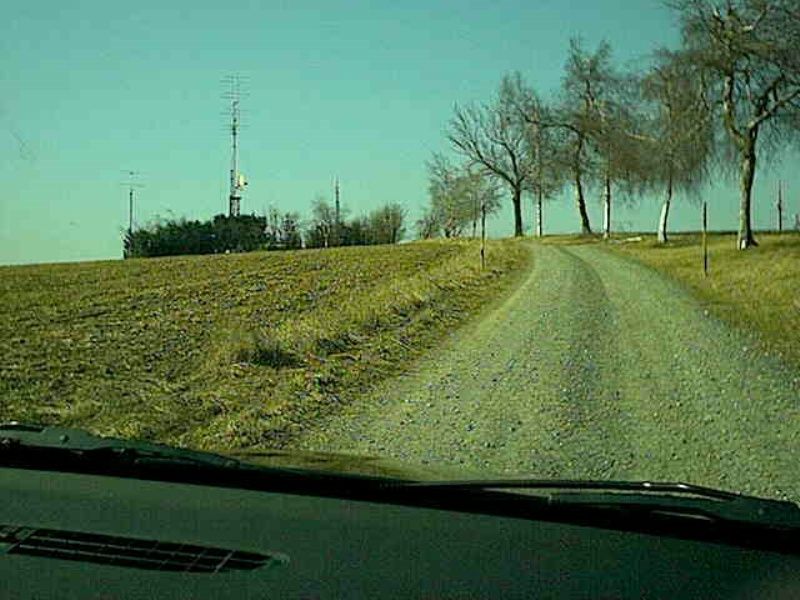
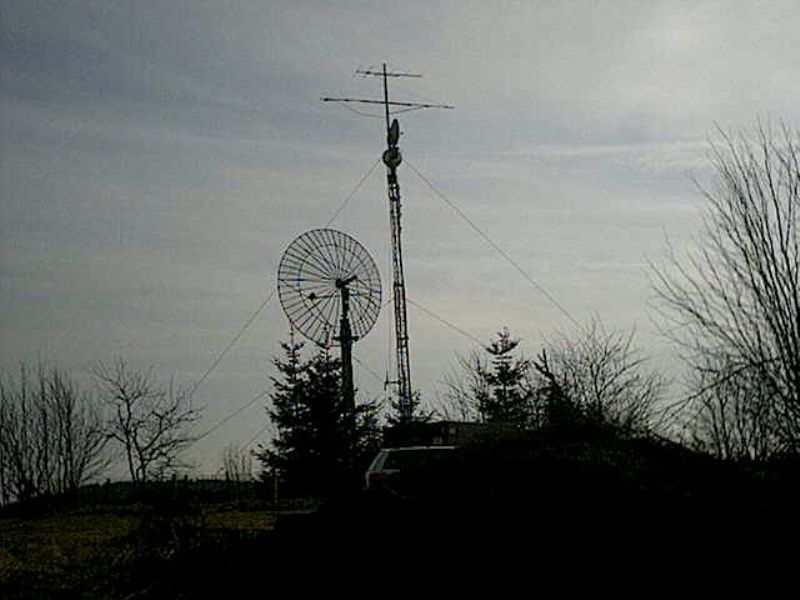
Michael took us up to the DK0NA site, it was from here that I first worked
Lorenz on 70cms in 1985. From it you can see the old GDR, it is also a very
good location. The shack is an old US army container while part of the mast
that holds the 4m dish is a pylon used for overhead electricity for trains.
It was nice to visit a station that I had worked from both the UK and
Switzerland.
We met up with Karel at Michaels factory in the early afternoon, it's quite
simple to find as it is next to an Erotica shop ! The DB6NT factory is a new
building with lots of light and space. The development work is done
there and it has a full set of small metalworking tools as well as
professional PCB making facilities. The test equipment that Michael has
available is truly staggering, he can perform measurements up to the
hundred's of GHz. In good amateur radio tradition, the factory is on a hill and he has a mast
there with some aerials on it. That day he had worked some G's on 70cms.
Michael took us up to the DK0NA site, it was from here that I first worked
Lorenz on 70cms in 1985. From it you can see the old GDR, it is also a very
good location. The shack is an old US army container while part of the mast
that holds the 4m dish is a pylon used for overhead electricity for trains.
It was nice to visit a station that I had worked from both the UK and
Switzerland.
After the tour and chat we and Karel went back to Lorenz's house to prepare
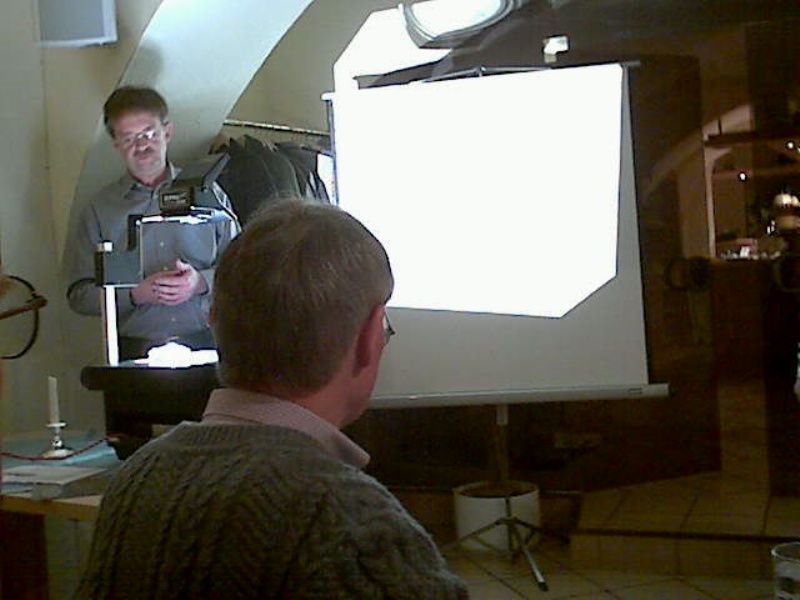
ourselves for the meeting in the evening. Michael was due to give a talk
about his new 2m and 70cms transverters at NOBUG Nordostbayerische UKW Gruppe
(North-East Bavarian VHF Group). This meets every two months to hear a
lecture on some technical topic and to eat good food, simultaneously. Karel
chose a Zürich specialty !
 Michael gave a detailed talk, starting with block diagrams, then detailing
the choice of active components, and finally going through the circuit
diagram. Finally he gave spectrum analyser plots to show the transmit performance, at the levels of performance that these transverters give, the
choice of HF radio becomes important. The only amateur radios that give
oscillator noise measurements are from Ten-Tec, and the Orion is
particularly good. As with all these meetings, what happened in the social
section was also interesting. I cannot hope to list all of the people that I
met there, but a few stuck in my mind as I had worked them on 3cms rain
scatter.
Michael gave a detailed talk, starting with block diagrams, then detailing
the choice of active components, and finally going through the circuit
diagram. Finally he gave spectrum analyser plots to show the transmit performance, at the levels of performance that these transverters give, the
choice of HF radio becomes important. The only amateur radios that give
oscillator noise measurements are from Ten-Tec, and the Orion is
particularly good. As with all these meetings, what happened in the social
section was also interesting. I cannot hope to list all of the people that I
met there, but a few stuck in my mind as I had worked them on 3cms rain
scatter.

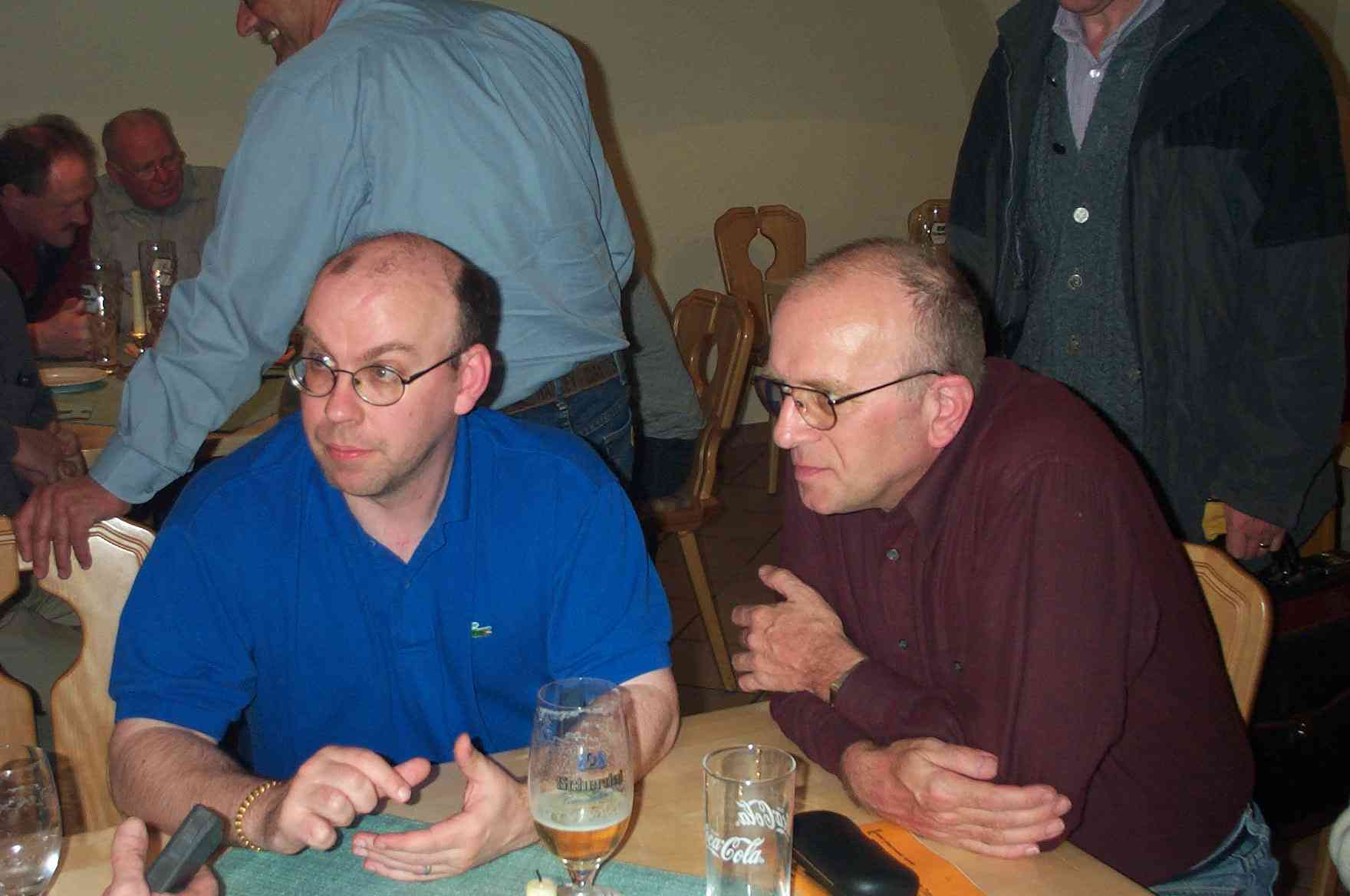
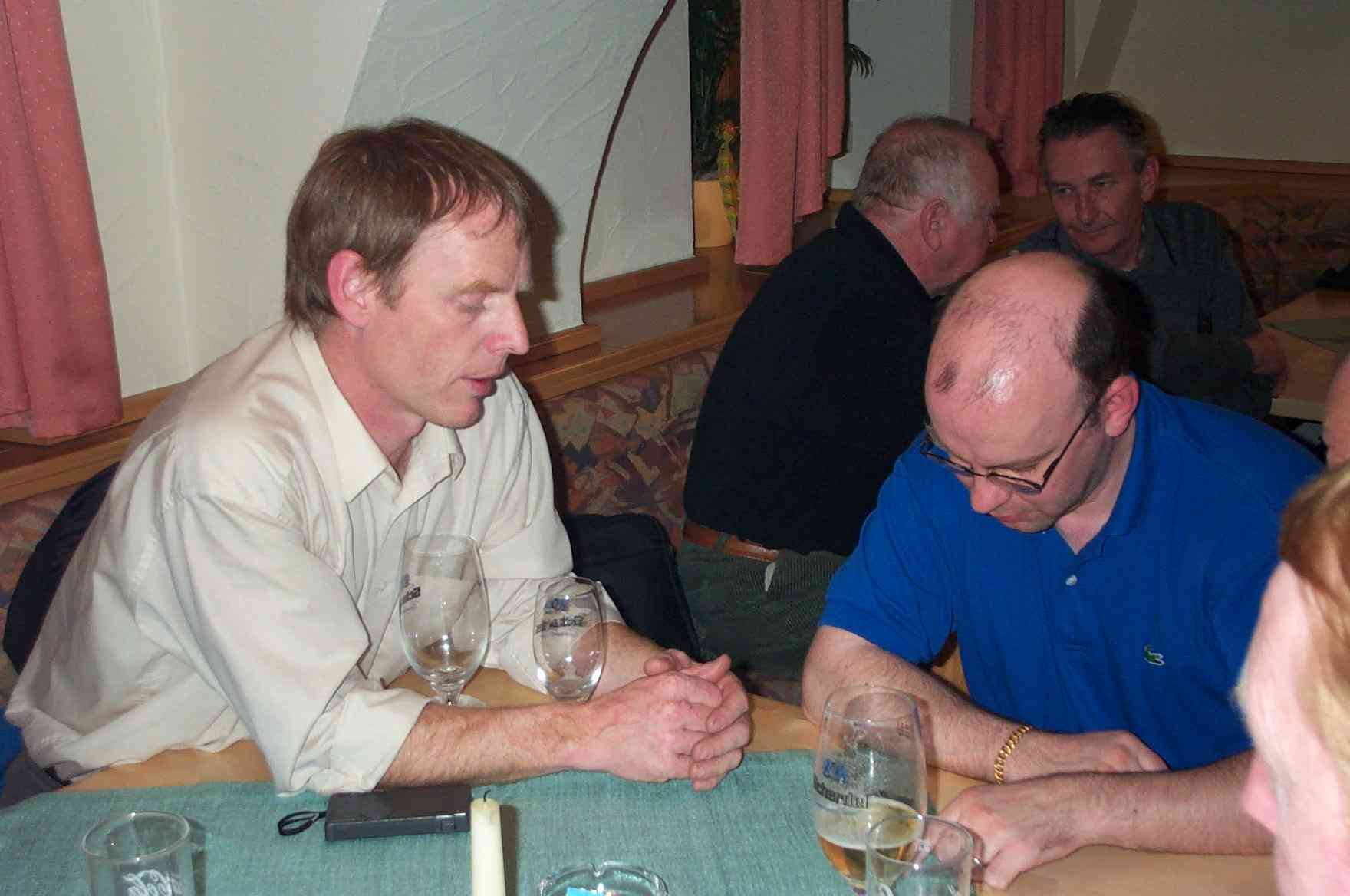
 On my table were Karel, Fritz DM2AFN and Norbert DL4DTU. Norbert told me
about his work on 23cms EME using 130W and a 2.5m dish, he even played me
some signals from HB9BBD. They were an easy 539 in a 2.5kHz bandwidth ! He
mentioned working Howard G4CCH off the moon with ease. I also got an
invitation to visit Dresden, but that will have to wait until I am more
settled, probably when I am back in the UK.
On my table were Karel, Fritz DM2AFN and Norbert DL4DTU. Norbert told me
about his work on 23cms EME using 130W and a 2.5m dish, he even played me
some signals from HB9BBD. They were an easy 539 in a 2.5kHz bandwidth ! He
mentioned working Howard G4CCH off the moon with ease. I also got an
invitation to visit Dresden, but that will have to wait until I am more
settled, probably when I am back in the UK.

 On the next table were amongst others Reinhold DL6NAA, Edi
DL6NCO and Willi
DK2GR. At this stage I had to drop down to my bad German, but enough was
said that everyone was happy at the end. Finally on another table was Erwin
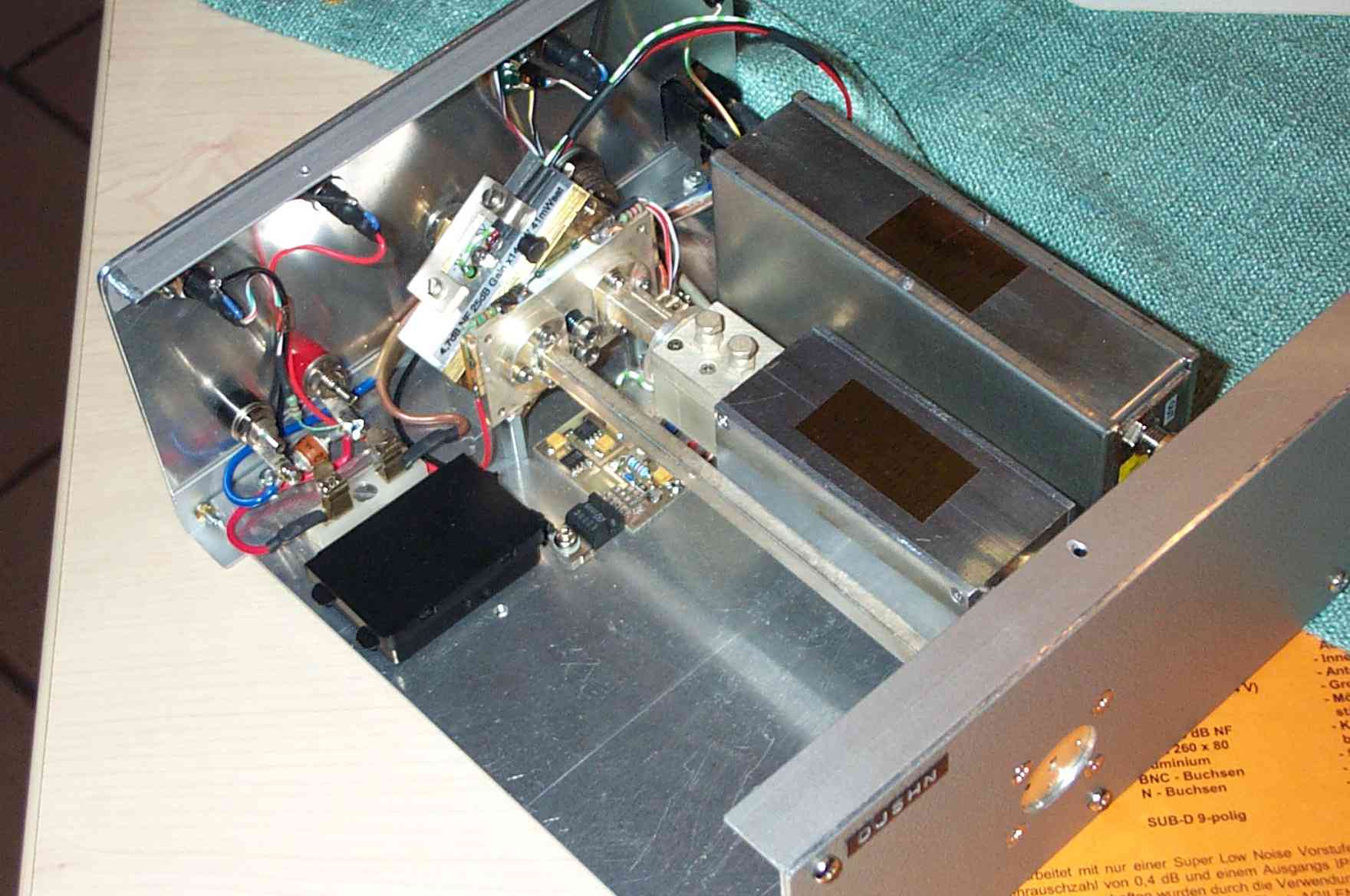
DJ5HN and Frank DJ5NQ. Erwin brought his 47GHz transverter using one of the
47GHz amplifiers that Michael described in DUBUS in 2002. This transverter
had a clever mechanical arrangement to swap the amplifier between transmit
and receive, and it gave 20mW on transmit and had a 4dB noise figure. There
is a magnet and reed switch arrangement so that transmit is only possible
when the amplifier is in the correct position.
On the next table were amongst others Reinhold DL6NAA, Edi
DL6NCO and Willi
DK2GR. At this stage I had to drop down to my bad German, but enough was
said that everyone was happy at the end. Finally on another table was Erwin
DJ5HN and Frank DJ5NQ. Erwin brought his 47GHz transverter using one of the
47GHz amplifiers that Michael described in DUBUS in 2002. This transverter
had a clever mechanical arrangement to swap the amplifier between transmit
and receive, and it gave 20mW on transmit and had a 4dB noise figure. There
is a magnet and reed switch arrangement so that transmit is only possible
when the amplifier is in the correct position.
We got back to Lorenz's house at around midnight and after chatting and
drinking Schnapps, I dropped into bed at 0130 MET.

 Saturday was my last half day with Lorenz. There was only one item left to
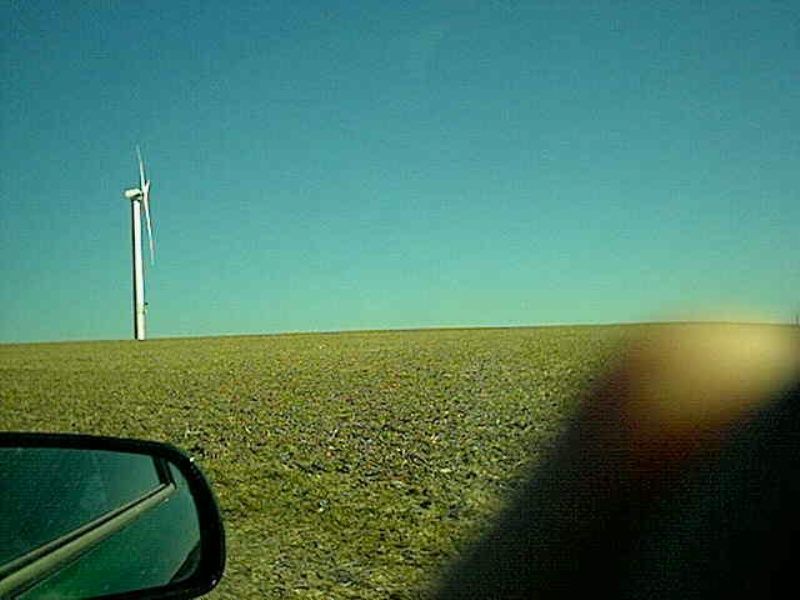
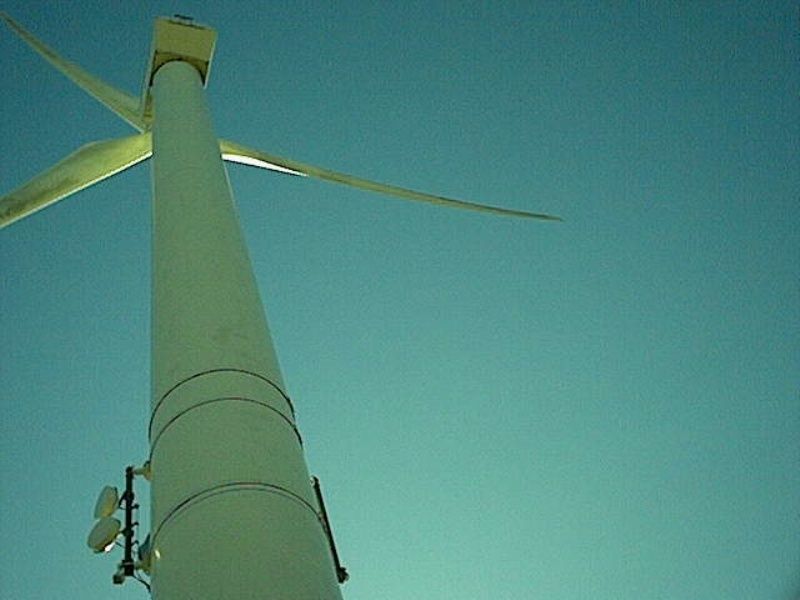
do and that was to visit Frank DJ5NQ's wind farm. Germany is much more
serious about clean power than the UK, if you go there you will see wind
farms on most hills, and they produce 4.7% of the electricity for the
country. We met up with Frank at 1000 MET and he gave us a tour of his wind
farm. The mast is very impressive and the sound of the blades going round
even more so, when we were there the end of the blades were at 150km/h and
they can reach 230km/h. The single generator can generate up to 600kW and
the average is 110kW throughout the year. Within the mast are two
generators, one for 200kW maximum and another for 600kW, which one depends
on the wind speed.
Saturday was my last half day with Lorenz. There was only one item left to
do and that was to visit Frank DJ5NQ's wind farm. Germany is much more
serious about clean power than the UK, if you go there you will see wind
farms on most hills, and they produce 4.7% of the electricity for the
country. We met up with Frank at 1000 MET and he gave us a tour of his wind
farm. The mast is very impressive and the sound of the blades going round
even more so, when we were there the end of the blades were at 150km/h and
they can reach 230km/h. The single generator can generate up to 600kW and
the average is 110kW throughout the year. Within the mast are two
generators, one for 200kW maximum and another for 600kW, which one depends
on the wind speed.
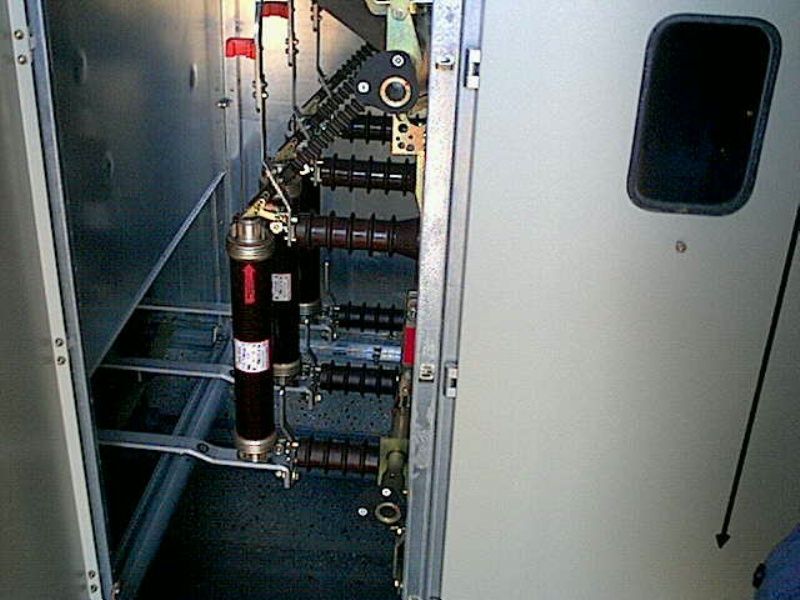
 The control system for this is very powerful and can give readouts on the
gear temperatures and other important values. It only needs any maintenance
every six months or so. In another building was the transformer to connect
it to the national grid of 20kV. Like at Lorenz's work, the fuses were
large, what was even more impressive was when Frank opened the door to the 20kV section and stuck in an indicator pole. As it approached the
20kV a
sizzling sound could be heard and the indicator lights came on.
The control system for this is very powerful and can give readouts on the
gear temperatures and other important values. It only needs any maintenance
every six months or so. In another building was the transformer to connect
it to the national grid of 20kV. Like at Lorenz's work, the fuses were
large, what was even more impressive was when Frank opened the door to the 20kV section and stuck in an indicator pole. As it approached the
20kV a
sizzling sound could be heard and the indicator lights came on.
We then went back to Lorenz's house and to pack everything up for the
journey home. We got to the station in plenty of time and the train was only
a couple of minutes late, I bade my farewells to Lorenz and Sabrina and
boarded the train at 1143 MET.
Like my journey there, my return journey was relatively tight on timing and
after my experience of the ICE to Hof, I was not at all happy that I would
get home when I wanted. The journey was certainly faster this time and I
hoped that things would not turn out too badly. We had a couple of short
waits and my twenty-five minute time cushion was rapidly disappearing, we
arrived at Nürnberg with only two minutes to spare so I ran and got the
train to Stuttgart. My experience with the IC had been better and I hoped
that the ten minute time cushion in Stuttgart would be enough, it was, just.
Yet again I had to sprint to the waiting train, instead of an ICE it was the
Cisalpino, the same train type that Richard Branson has ordered for Virgin
rail. It didn't much matter now, I was on the final leg back to Zürich and
the only connection was with the Zürich city tram system which runs every
six minutes anyway.
Although I am no big fan of Switzerland, I must say it was nice to see names
and places that I am familiar with after a long day traveling. What is a
little strange is that if you take one particular train route from
Schaffhausen to Zürich, both of which are in Switzerland, you actually go
back into Germany for a while en route. The train was on time arriving in
Switzerland and I made my way to the Kiosk to buy a British newspaper to
plug myself back into reality. A very tired HB9DRD arrived back in his flat
at around 1930 MET.
I had an amazing time in JO50. The amount of activity is incredibly high,
there are probably more active 3cms operators in JO50 than in the whole of
the UK. The chances of making a QSO on 24GHz and 47GHz are also high in that
area and having access to beacons on those bands is a big plus. If anyone is
thinking of a holiday in that part of Germany then I would highly recommend
that you take microwave equipment with you and contact Lorenz and/or Michael
beforehand, you can be guaranteed some QSOs. There are a great many easily accessible
portable locations that would guarantee you many contacts on the
higher bands. Failing that I can recommend the local beer.
I would like to express my sincere thanks
to Lorenz, Jutta, Sabrina and Manuel for putting up with me for four days. I
would also like to say thank you to Reinhold for the gift of the 2C39's which
will go a long way to getting me onto 23cms EME in the future. I cannot forget
the friendship shown by Michael, Karel, Matthias, Erwin, Wolfgang, Violetta,
Fritz, Norbert, Edi, and Willi. If I have left your name out, let me know, my
memory is not as good as it used to be.
Last
updated on 31.03.2003
 At this stage of the journey I phoned ahead to Lorenz and told him that I
would be arriving on time, big mistake. After leaving Bayreuth the ICE
became an "Inter City Extremely slow", and we moved extremely slowly through
the Bavarian countryside. I decided to read the supplied train magazine and
read an article about Ellen MacArthur the yachtswoman who comes from
Whatstandwell in Derbyshire and went to the same school as me. A small
world. After a while I looked out of the window and saw three masts which I
guessed contained the DB0KI and DB0FGB beacons, the presence of the third
one was surprising for me though. The train eventually arrived in Hof about
thirty minutes late after being given a push by some passing snails who felt
sorry for it. Poor old Lorenz and his son Manuel had waited all that time
for me. Although the sun was still out at 1650 MET, there was also a cold
wind which must have made it a thoroughly miserable experience for them.
At this stage of the journey I phoned ahead to Lorenz and told him that I
would be arriving on time, big mistake. After leaving Bayreuth the ICE
became an "Inter City Extremely slow", and we moved extremely slowly through
the Bavarian countryside. I decided to read the supplied train magazine and
read an article about Ellen MacArthur the yachtswoman who comes from
Whatstandwell in Derbyshire and went to the same school as me. A small
world. After a while I looked out of the window and saw three masts which I
guessed contained the DB0KI and DB0FGB beacons, the presence of the third
one was surprising for me though. The train eventually arrived in Hof about
thirty minutes late after being given a push by some passing snails who felt
sorry for it. Poor old Lorenz and his son Manuel had waited all that time
for me. Although the sun was still out at 1650 MET, there was also a cold
wind which must have made it a thoroughly miserable experience for them.